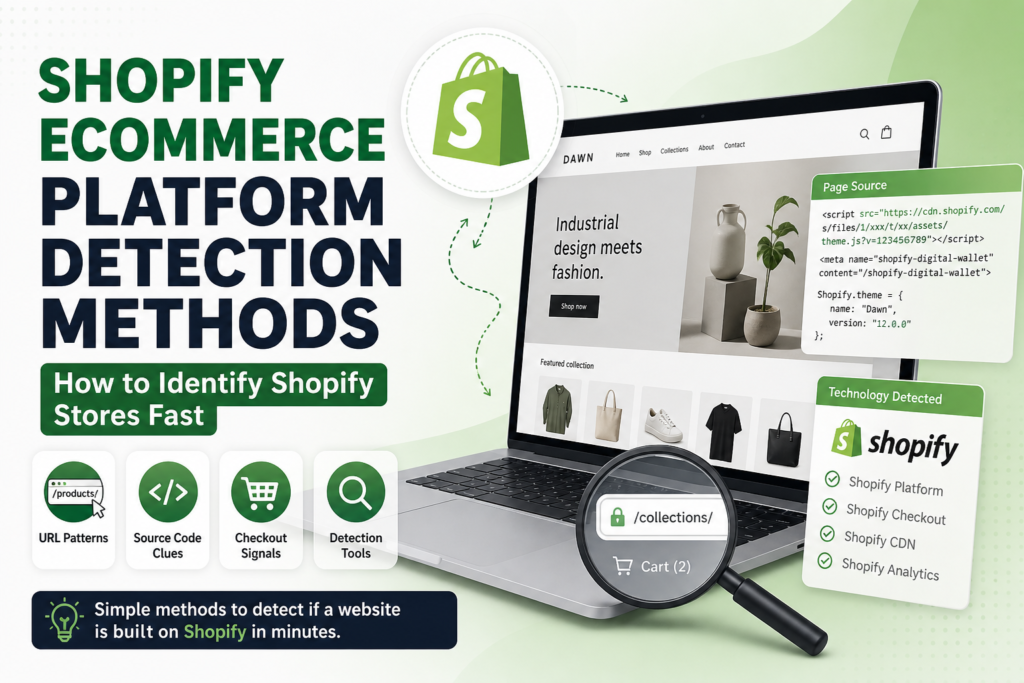
Shopify Ecommerce Platform Detection Methods: How to Identify Stores Built on Shopify
Understanding Shopify ecommerce platform detection methods helps marketers, founders, and affiliate researchers quickly recognise whether an online store is powered by Shopify. Instead of guessing, you can look for clear signals such as Shopify checkout URLs, theme file structures, app scripts, product URL formats, and source-code clues. For example, if a store uses URLs like /products/, /collections/, or redirects checkout through Shopify’s secure system, there is a strong chance it is using Shopify.
1. Check Shopify Store URLs and Checkout Behaviour
One of the easiest detection methods is to study the store’s URL structure. Shopify stores often use familiar paths like /products/product-name, /collections/category-name, and /cart. A real-world example would be an online clothing store where every item page follows the same clean product URL format. You can also add a product to the basket and observe the checkout process. If the checkout loads through Shopify’s secure hosted checkout, that is a major clue. This method is simple, fast, and useful when researching competitors or analysing successful ecommerce websites.
2. Inspect the Page Source for Shopify Themes and Scripts
Another reliable way to identify Shopify is by checking the page source. Right-click on a webpage, select “View Page Source,” and search for words like Shopify, cdn.shopify.com, Shopify.theme, or ShopifyAnalytics. For example, if a beauty product website loads images, JavaScript, or theme files from Shopify’s CDN, it strongly indicates the site is using Shopify. This is one of the most practical Shopify ecommerce platform detection methods because it gives technical evidence rather than relying only on design appearance.
3. Use Browser Extensions and Ecommerce Technology Tools
If you want a faster approach, technology detection tools and browser extensions can scan a website and show whether it uses Shopify, WooCommerce, BigCommerce, or another ecommerce platform. For example, tools like technology lookup extensions can detect Shopify apps, payment tools, analytics tags, and storefront scripts within seconds. This is especially useful when building an affiliate research list, studying high-performing stores, or comparing ecommerce platforms. The key is to use the keyword naturally: do not repeat Shopify ecommerce platform detection methods too many times. Google rewards helpful content, not keyword stuffing.
Try Shopify for Your Online StoreShopify Ecommerce Platform Detection Methods Comparison
Here’s a simplified breakdown of the most effective Shopify ecommerce platform detection methods, so you can quickly choose the best approach depending on your goal:
| Detection Method | How It Works | Difficulty Level | Accuracy | Best Use Case |
|---|---|---|---|---|
| URL Structure Analysis | Checks patterns like /products/, /collections/, /cart | Easy | Medium | Quick manual checks |
| Checkout Behaviour | Observes Shopify-hosted checkout flow | Easy | High | Confirming platform before analysis |
| Page Source Inspection | Search for cdn.shopify.com, Shopify scripts | Medium | Very High | Technical verification |
| Browser Extensions | Uses tools to auto-detect ecommerce platforms | Very Easy | High | Bulk research & competitor analysis |
| App & Script Detection | Identifies Shopify apps and integrations | Medium | Very High | Advanced store analysis |